
2026 PRICING GUIDE
How Much Does a Concrete Patio Cost in Temple, TX? (2026)
By Agaves Landscape Construction & Irrigation · Updated · 10 min read
Quick answer
A reinforced concrete patio in Temple typically runs about $7–$11 per square foot, and a stamped patio about $9–$16, according to a published Temple cost survey.
- Plain reinforced slab (Temple): about $7–$11 per sq ft; un-reinforced $6–$10 (HomeBlue, Temple TX).
- Stamped (Temple): about $9–$16 per sq ft reinforced (HomeBlue, Temple TX); Fixr’s national range is $8–$12 basic, $12–$18 mid-range.
- Broom finish: the standard finish on a plain slab; Homewyse’s national broom-finish patio estimate is $10.59–$12.99 per sq ft, before excavation and base.
- Stained: add about $3–$11 per sq ft to the slab for basic to intermediate exterior stain (Concrete Network, national).
- Exposed aggregate: about $14.11–$17.22 per sq ft installed (Homewyse, national, Sept. 2026).
- Tearing out an old slab first: about $2–$6 per sq ft including haul-off (Fixr, national).
At the Temple survey rate, a 12×16 plain patio works out to roughly $1,340–$2,110 and a 16×20 to roughly $2,240–$3,520; stamping the same 16×20 pushes it to about $2,880–$5,120. Site prep on Blackland clay moves the total more than the finish does. Agaves has not published prices; we quote each patio after seeing the yard, with a free written estimate.
These are published area averages from the sources listed at the end of this guide, not an Agaves price list. Sergio prices every job after walking the property, and the consultation is free.
What actually drives the cost of a concrete patio
Five things set the price of a concrete patio: its size, the finish, how much the ground has to be dug and built up, how the slab is reinforced, and what is already in the way. The concrete itself is a smaller share than most people expect; forming, prep, and finishing labor are most of the bill.
1. Square footage
Size is the biggest driver because nearly every cost is charged by the square foot. Small slabs cost more per foot, though: the truck, the crew, and the forming setup cost about the same for 100 sq ft as for 250.
2. Finish
A broom finish is the baseline. Stamping, staining, and exposed aggregate each add labor and material, and a stamped patio in the Temple survey runs about $2–$5 more per square foot than a plain one at the same reinforcement.
3. Site prep and base
On Blackland Prairie clay, what goes under the slab matters more than what goes on top. Stripping sod, cutting to grade, and bringing in and compacting a base are labor-heavy, and Homewyse’s national patio estimate specifically leaves excavation, the gravel base, and demolition out of its per-foot number.
4. Thickness and reinforcement
Thicker and reinforced slabs cost more but crack less. LawnStarter’s national figures put a 4-inch slab at about $5.35 per sq ft and a 6-inch slab at about $6.19, and the Temple survey shows reinforced concrete running about $1 per sq ft over un-reinforced.
5. What has to come out or move first
An old cracked slab, a flower bed, or sprinkler lines in the footprint all have to be dealt with before forming. Removal and haul-off is its own line, and irrigation lines under the pour need to be rerouted before the truck arrives, not after.
Concrete patio cost per square foot by finish
A plain broom-finished slab is the cheapest patio; stamped and exposed aggregate cost the most. The ranges below are published third-party figures, labelled as Temple or national. They are not Agaves prices.
| Finish | Typical range per sq ft | Source / notes |
|---|---|---|
| Plain, reinforced (Temple) | $7–$11 | HomeBlue, Temple TX, April 2022 |
| Plain, un-reinforced (Temple) | $6–$10 | HomeBlue, Temple TX, April 2022 |
| Broom finish (national) | $10.59–$12.99 | Homewyse, Sept. 2026; 4-inch, fiber-reinforced, excludes excavation and base |
| Stamped, reinforced (Temple) | $9–$16 | HomeBlue, Temple TX, April 2022 |
| Stamped (national) | $8–$12 basic; $12–$18 mid-range; $18–$30 complex | Fixr, Jan. 2025 |
| Stained (added to the slab) | $3–$11 | Concrete Network, national, Feb. 2026; basic to intermediate exterior stain |
| Exposed aggregate (national) | $14.11–$17.22 | Homewyse, Sept. 2026 |
| Killeen comparison, plain / stamped | $6–$11 / $9–$15 | HomeBlue, Killeen TX, April 2022 |
Plain and broom finish
A broom finish is a plain slab dragged with a stiff broom while it sets, which leaves a fine texture that grips when wet. It is the standard finish, and most contractors include it in the plain-slab price. It is the right call for a working patio, a grill pad, or a side-yard path where looks matter less than budget.
Stamped
Stamped concrete is pressed with patterned mats to look like stone, slate, or brick, usually with color added. The Temple survey puts it at about $9–$16 per sq ft reinforced, and Fixr’s national average is about $3,073 for a 200 sq ft octagon-stamped patio. The catch on clay soil: a crack through a stamped pattern is hard to hide, and a patch rarely matches.
Stained
Staining colors the surface of a finished slab, either on a new pour or on an existing patio in good shape. Concrete Network puts outdoor staining at about $3–$11 per sq ft for basic to intermediate work, on top of the slab itself. It is a cheaper way to get color than stamping, and it can freshen a sound older patio without a tear-out.
Exposed aggregate
Exposed aggregate has the top layer of cement washed off so the gravel shows, which gives a pebbled, non-slip surface. Homewyse puts it at about $14.11–$17.22 per sq ft nationally. It is popular around pools because it grips well underfoot, but it is rougher on bare feet than a broom finish.
Concrete patio cost by size in Temple
Multiply the area by the per-foot rate for a starting range. The figures below apply the Temple survey rates ($7–$11 plain, $9–$16 stamped, both reinforced) to common sizes; they are arithmetic on published averages, not quotes.
| Size | Area | Plain / broom | Stamped |
|---|---|---|---|
| About 10×12 | 120 sq ft | $840–$1,320 | $1,080–$1,920 |
| About 12×16 | 192 sq ft | $1,340–$2,110 | $1,730–$3,070 |
| About 16×20 | 320 sq ft | $2,240–$3,520 | $2,880–$5,120 |
| Pool deck, about 600 sq ft | 600 sq ft | $4,200–$6,600 | $5,400–$9,600 |
Small: about 10×12 (120 sq ft)
A 10×12 slab fits a small table and a grill, or a pair of chairs off the back door. It comes to roughly $840–$1,320 plain at the Temple rate. The survey’s own 10×10 example is $700–$1,100. Expect small jobs to price toward the top of any range because setup is spread over fewer feet.
Medium: about 12×16 (192 sq ft)
A 12×16 patio holds a dining table for six with room to pull chairs back. At the Temple rate it works out to about $1,340–$2,110 plain and $1,730–$3,070 stamped. The survey’s closest example, a 12×14, is $1,100–$1,900 plain.
Large: about 16×20 (320 sq ft)
A 16×20 patio gives room for both a dining set and a separate seating area. It comes to roughly $2,240–$3,520 plain and $2,880–$5,120 stamped at the Temple rate. The survey’s 16×18 example is $1,900–$3,200 plain and $2,600–$4,500 stamped.
Pool deck
A pool deck is priced like a patio but is usually bigger and needs a finish that grips wet feet. Homewyse’s national pool-deck estimate is about $10.38–$12.74 per sq ft for a broom-finished, fiber-reinforced deck, which puts 600 sq ft at about $6,230–$7,640. At the Temple plain rate the same area is about $4,200–$6,600. See our concrete patio and pool decking page for how we handle the edges and drainage.
Extending a builder slab, and adding a walkway
Extending the small slab a builder poured costs about the same per square foot as a new patio, and it is usually cheaper overall than tearing out and starting over.
Extending an existing patio
Many Temple and Belton homes come with a slab barely big enough for two chairs. An extension adds new concrete against that slab, tied in with steel dowels drilled into the old edge so the two pieces move together instead of shearing apart. A 12×21 extension (252 sq ft) works out to about $1,760–$2,770 at the Temple plain rate. The new pour has to match the old slab’s height and continue its slope away from the house; a mismatch at the joint is where water pools and trips start.
Walkways
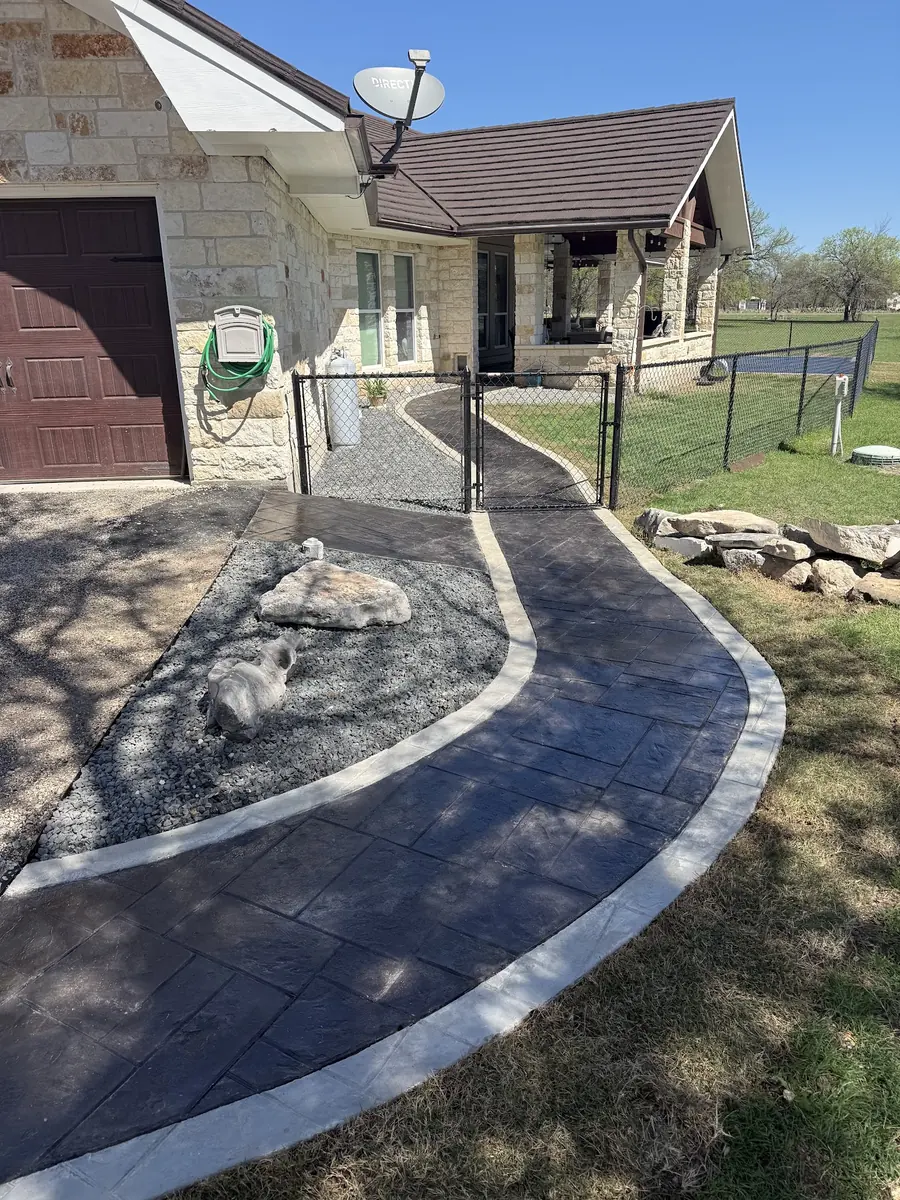
A concrete walkway is priced like a narrow patio. Homewyse puts a broom-finished sidewalk at about $12.33–$15.10 per sq ft nationally, so a 4-foot-wide, 40-foot path (160 sq ft) comes to about $1,970–$2,420. Stamped at the Temple rate, the same path is about $1,440–$2,560. Pouring the walkway with the patio saves a second trip for the truck and crew. A walkway is also a natural edge for concrete landscape curbing along the beds beside it.
Base, rebar, and thickness on Blackland Prairie clay
Concrete patios in Temple crack mainly because the Blackland Prairie clay underneath swells when it gets wet and shrinks when it dries, and a thin, unreinforced slab cannot ride that movement. After a dry August the ground can open cracks you can put a finger in; after a week of fall rain it heaves back up.
Every slab cracks somewhere eventually. The goal is to control where it cracks and keep the pieces from separating or lifting. That comes down to four things, and they are the parts a low bid is most likely to skimp on:
- Base: strip the topsoil and roots, compact the subgrade, and put down a compacted layer of base material so the slab is not sitting directly on organic soil.
- Reinforcement: rebar on a grid or wire mesh, held up in the middle of the slab on chairs, not lying in the dirt where it does nothing. Fiber in the mix helps with surface cracking but is not a replacement for steel on clay.
- Thickness: 4 inches is the common patio minimum; areas that will carry a hot tub, a heavy grill island, or occasional vehicle weight need more.
- Control joints: grooves cut or tooled at regular spacing so the slab cracks in a straight line inside the joint instead of randomly across the surface.
West toward Killeen and Harker Heights the ground turns rockier, with limestone close to the surface. That trades the swelling problem for a digging problem: cutting to grade can mean breaking rock, which adds equipment time. Our Belton and Killeen patio pages cover those areas specifically.
Drainage and slope away from the house
A patio must slope away from the house, and on Temple clay that slope protects the foundation as much as the patio. A common rule of thumb is about 1/8 to 1/4 inch of fall per foot, enough that water runs off without the table rocking.
A slab that tilts toward the house, or that dams water against the foundation, keeps the clay under the house wetter than the clay around it. Uneven moisture is what makes foundations move. If the yard itself drains toward the house, the grade may need correcting before the patio is formed, and that is cheaper to do in the same visit than as a repair later.
Watch where downspouts discharge, too. A gutter emptying onto the patio edge will soak the clay at that corner and is a common reason one corner of a slab drops.
Removing an old concrete patio first
Tearing out an old patio typically adds about $2–$6 per sq ft including haul-off, and Fixr puts a typical patio removal at about $1,000–$2,000 nationally. The Temple survey lists demolition alone at about $1.20–$1.90 per sq ft, before disposal.
Reinforced concrete costs more to remove: Fixr puts it at about $4–$6 per sq ft versus $2–$4 for un-reinforced. A 12×16 slab (192 sq ft) comes to roughly $380–$1,150 to remove at Fixr’s range. If the old slab cracked because the clay moved, the ground under it usually needs regrading and a new base too, so plan on prep work beyond just breaking and hauling.
Sealing a concrete patio
Sealing is optional on a plain broom-finished patio and strongly recommended on stamped or stained concrete, where it protects the color. Homewyse’s September 2026 national estimates put a penetrating sealer at about $0.91–$1.07 per sq ft and an acrylic sealer at about $1.56–$1.85.
For a 320 sq ft patio that is about $290–$340 penetrating or $500–$590 acrylic. Acrylic gives the wet-look sheen people like on stamped concrete but wears in full Texas sun and needs recoating every few years; penetrating sealers are invisible and last longer but add no shine.
Local factors in Temple, Belton, and Killeen
Five local conditions change what a concrete patio costs here: clay versus limestone, summer heat, permits, HOA rules, and season.
- Clay in Temple and Belton, rock toward Killeen: clay means more base and reinforcement; limestone means more digging effort. Both show up in labor.
- Summer heat: concrete poured in 100-degree afternoons sets fast and can crack at the surface. Summer pours are often scheduled early in the morning, and curing needs attention.
- City permits: the City of Temple’s published permit fee schedule lists a $35 permit for a “Carport, Shed, Deck, or Patio” and a $35 permit for “Flatwork, Driveway, or Paving.” Confirm with the city whether your job needs one before work starts; Belton, Killeen, and Harker Heights have their own rules.
- HOAs: many newer subdivisions require approval for hardscape, and some limit how close a slab can come to a property line or easement. Ask before the pour is scheduled.
- Sprinklers: a new patio often sits on top of existing sprinkler lines. Rerouting them is a separate line on most quotes; see our irrigation page.
Mistakes that cost homeowners money
1. Hiring on price alone
The lowest bid is usually the thinnest base and the least steel. Two patios can look identical on day one and be completely different after two Temple summers.
2. Pouring too small
Extending later means a second mobilization and a visible joint. Lay a hose or spray paint on the grass and set the table and chairs inside it before settling on a size.
3. Ignoring the slope
A patio that drains toward the house is a foundation problem in the making on expansive clay. Ask which way the water goes and how much fall is planned.
4. Stamping over a bad base
Paying for a decorative finish on a slab that will crack from poor prep wastes the most money of any mistake here, because a crack through a stamped pattern cannot be patched invisibly.
5. Skipping control joints and sealing
Joints spaced too far apart let the slab crack where it wants. On stamped or stained concrete, skipping the sealer lets the color fade in a few summers.
How to compare concrete patio quotes
Compare quotes line by line on prep and reinforcement, not on the bottom number. A written quote for a concrete patio should spell out:
- Finished size in square feet and the finish (broom, stamped pattern and color, stain, or exposed aggregate).
- Slab thickness and concrete strength.
- Reinforcement: rebar or mesh, size and spacing, and how it is held up in the slab.
- Excavation depth and base material.
- Slope direction and any grading or drainage work.
- How it ties into an existing slab or the house, if it is an extension.
- Removal and haul-off of an old slab, sod, or soil.
- Control joint spacing and whether sealing is included.
- Sprinkler rerouting, permit, and cleanup.
Agaves does not publish set prices because the soil, access, and drainage change from yard to yard. We look at the site and give a free written estimate that lists each of these items. You can request an estimate or see finished patios and walkways on our work page.
FAQs
THE SERVICE
Concrete Patios & Walkways from Agaves
Concrete patios and patio extensions, pool decking, and stamped walkways — formed, poured, and finished to drain right.
Sources
- HomeBlue — Concrete Patio Cost in Temple, TX — Temple, TX; plain $7–$11/sq ft reinforced ($6–$10 un-reinforced), stamped $9–$16, demolition $1.20–$1.90/sq ft, size examples; April 2022
- HomeBlue — Concrete Patio Cost in Killeen, TX — Killeen, TX; plain $6–$11/sq ft, stamped $9–$15 (reinforced); April 2022
- Homewyse — Cost to Install Concrete Patio — national; $10.59–$12.99/sq ft, 4-inch broom finish, excludes excavation, base, demolition; Sept. 2026
- Homewyse — Cost to Install Exposed Aggregate Patio — national; $14.11–$17.22/sq ft; Sept. 2026
- Homewyse — Cost to Install Concrete Pool Deck — national; $10.38–$12.74/sq ft; Sept. 2026
- Homewyse — Cost to Install Concrete Sidewalk — national; $12.33–$15.10/sq ft; Sept. 2026
- Homewyse — Cost to Apply Penetrating Concrete Sealer — national; $0.91–$1.07/sq ft; Sept. 2026
- Homewyse — Cost to Apply Acrylic Concrete Sealer — national; $1.56–$1.85/sq ft; Sept. 2026
- Fixr — Stamped Concrete Patio Cost — national; $8–$12 basic, $12–$18 mid-range, $18–$30 complex; $3,073 average for 200 sq ft; Jan. 2025
- Fixr — Concrete Removal Cost — national; $2–$6/sq ft, reinforced $4–$6, patio removal $1,000–$2,000, disposal $0.50–$2/sq ft; Jan. 2025
- LawnStarter — How Much Does a Concrete Patio Cost? — national; 4-inch slab $5.35/sq ft, 6-inch $6.19; Dec. 2024
- Concrete Network — Cost to Stain Concrete — national; outdoor staining $3–$11/sq ft basic to intermediate; Feb. 2026
- City of Temple — Permit Fee Schedule — Temple, TX; Carport, Shed, Deck, or Patio $35; Flatwork, Driveway, or Paving $35
More cost guides
TEMPLE, TEXAS — 31.0982° N, 97.3428° W
GET YOUR OWN NUMBER.
Averages only go so far. Sergio will walk the property with you and give you one price for the whole job — free, with no surprises after.