
2026 PRICING GUIDE
How Much Does Landscaping Cost in Temple, TX? (2026) — Front & Backyard Design-Build Pricing
By Agaves Landscape Construction & Irrigation · Updated · 11 min read
Quick answer
Professionally installed landscaping costs about $4.50–$14.50 per square foot in published 2026 national cost surveys, so most Temple-area front yards land in the mid four figures and full backyard builds in the high four to low five figures.
- Stand-alone landscape design: about $1,400–$6,900 for a plan, per national surveys; designers bill roughly $50–$150 an hour.
- Front-yard bed refresh (200–500 sq ft): roughly $900–$7,250 at the national per-square-foot rate.
- Full front yard: national averages put it around $4,000–$6,000; about 1,000 sq ft of work runs $4,500–$14,500.
- Backyard build (patio, curbing, sod, two beds): roughly $6,000–$13,500 using published Temple and national line-item rates.
- New-construction full yard (about 2,000 sq ft): $9,000–$29,000 at the national per-square-foot rate.
The biggest swing is not plants; it is how much concrete and turf the plan includes. These are third-party area and national averages, not Agaves prices. Agaves has not published prices and quotes each yard after a free on-site consultation, with one written estimate for the whole plan.
These are published area averages from the sources listed at the end of this guide, not an Agaves price list. Sergio prices every job after walking the property, and the consultation is free.
Design fee vs. design-build: what you are paying for
A stand-alone landscape design costs about $1,390–$6,850 in LawnStarter’s 2026 national figures, and you still have to hire someone to build it. Other national surveys land in the same place: Lawn Love puts a designer’s fee at about $1,900–$6,800 for a project, and Fixr puts a detailed plan at $2,000–$7,000.
Designers who bill hourly charge roughly $50–$150 an hour, and licensed landscape architects about $65–$200 an hour, per LawnStarter’s landscape design cost guide. That route makes sense for estates, commercial sites, or anything that needs stamped drawings.
Design-build is the other route: the same company walks the yard, lays out the plan, and prices and builds it. For most houses in Temple, Belton, and Killeen, that means one plan, one estimate, and one crew instead of a designer, a concrete contractor, and a sod crew working from different drawings. That is how Agaves landscape design works: Sergio walks the front and back with you, then comes back with a plan and one number for the whole thing.
What actually drives the cost of landscaping
Five things set the price of a landscaping job: square footage, the mix of hardscape and softscape, site prep, plant size, and access. Of these, how much concrete goes in usually moves the number most.
1. Square footage
Landscaping is estimated by area, so size is the starting number. LawnStarter’s 2026 figures scale straight with area: about $900–$2,900 for 200 sq ft, $2,250–$7,250 for 500 sq ft, and $4,500–$14,500 for 1,000 sq ft.
2. Hardscape vs. softscape
Concrete costs far more per square foot than planting. A plain reinforced patio in Temple runs about $7–$11 per sq ft in HomeBlue’s local survey, while installed sod there runs about $1.20–$1.70. A plan heavy on patio and walkway will cost several times one built mostly from beds and turf.
3. Site prep and grading
Removing old grass, reshaping beds, and fixing grade all come before anything pretty goes in. LawnStarter puts land grading at about $1,175–$3,645 nationally. New-construction lots with builder fill and a bare slab edge often need the most prep.
4. Plant size and count
Shrubs run about $25–$230 each installed and trees about $565–$680 each in LawnStarter’s figures. A bed planted with 1-gallon perennials costs a fraction of one planted with large shrubs and a specimen tree.
5. Access and the ground itself
Tight side yards, no gate wide enough for equipment, and hard ground all add labor. Temple and eastern Belton sit on Blackland Prairie clay that is sticky when wet and brick-hard in August; lots west toward Killeen and Harker Heights hit shallow limestone that slows digging for beds and footings.
Landscaping line-item costs
A whole-yard estimate is really a stack of line items, and knowing the going rate for each makes any quote easier to read. Figures marked Temple come from a local survey; the rest are national averages.
| Item | Typical range | Notes |
|---|---|---|
| Landscape design (stand-alone) | $1,390–$6,850 per plan | National; hourly $50–$150 |
| Flower bed, installed | $865–$3,000 per bed | National; size and plant count drive it |
| Shrubs | $25–$230 each | National; container size matters most |
| Trees | $565–$680 each | National; larger specimens cost more |
| Mulching | $77–$94 per cubic yard | National; one yard covers about 108 sq ft at 3 inches |
| River rock (material) | $45–$140 per cubic yard | National; labor extra, about 2 hours per ton |
| Concrete landscape curbing | $6–$14 per linear foot | National; most land at $8–$10 |
| Sod, installed (Temple) | $1.20–$1.70 per sq ft | Local survey, averaging about $1.40 |
| Concrete patio, plain (Temple) | $7–$11 per sq ft | Local survey; stamped $9–$16 |
| Landscape lighting | $2,000–$4,500 | National; per system |
| Sprinkler system | $0.29–$0.48 per sq ft | National; new install |
| Land grading | $1,175–$3,645 | National; only where drainage needs it |
Each of these is its own trade, and the details live on their own pages: concrete curbing, patios and walkways, sod and planting, and irrigation. In a design-build job they are priced together as one plan.
Landscaping cost by project size
Most residential jobs around Temple fall into one of four tiers. The ranges below are built from published per-square-foot and line-item averages, so treat them as a sanity check, not a quote.
| Project | Typical scope | Rough range |
|---|---|---|
| Front-yard refresh | 200–500 sq ft of beds, new mulch or rock, a few shrubs | $900–$7,250 |
| Full front yard | Beds rebuilt, curbing, sod patched or replaced | $4,000–$6,000 national average; $4,500–$14,500 for ~1,000 sq ft |
| Backyard build | 250 sq ft patio, 150 ft curbing, 1,500 sq ft sod, two beds | About $6,000–$13,500 |
| New-construction full yard | About 2,000 sq ft of beds, turf, and edging front and back | $9,000–$29,000 |
Front-yard refresh
A refresh reworks the beds along the house and walk without touching the lawn. At LawnStarter’s national rate, 200 sq ft of work runs about $900–$2,900 and 500 sq ft about $2,250–$7,250; plant size decides where in that range you land.
Full front yard
A full front yard adds curbing, reshaped beds, and new or patched turf. Fixr puts a typical front yard at about $4,000–$6,000 nationally. For scale, 120 feet of curbing at $6–$14 a foot is $720–$1,680, and 800 sq ft of Temple-rate sod is about $960–$1,360.
Backyard build with patio, curbing, and sod
A typical backyard build lands around $6,000–$13,500 when you add up published rates. That example is a 250 sq ft plain patio at Temple’s $7–$11 per sq ft ($1,750–$2,750), 150 feet of curbing ($900–$2,100), 1,500 sq ft of sod ($1,800–$2,550), and two planted beds ($1,730–$6,000). Fixr’s national backyard average of $8,000–$10,000 sits inside that range. Lighting, trees, or stamped concrete push it higher.
New-construction full yard
A new build with bare dirt or builder sod needs the most work: grading, beds, edging, and turf front and back. At LawnStarter’s national rate, 2,000 sq ft runs about $9,000–$29,000. Doing it once, from one plan, avoids tearing out year-one work in year three.
Xeriscape and drought-tolerant plants: cost and what grows here
Xeriscaping costs more to install than a basic bed-and-lawn yard but less to water and maintain. Lawn Love puts a 1,200 sq ft xeriscape at about $11,600–$20,000 nationally, roughly $10–$17 per sq ft, because rock, soil prep, and larger specimen plants replace cheap turf.
The plants that do best here are the ones Texas A&M AgriLife lists as native and adapted to Central Texas. The AgriLife and City of Austin native and adapted plants guide lists these among its low-water choices once established:
- Agave (Parry’s agave, Queen Victoria agave, and others): very low water; needs well-drained soil.
- Yucca and red yucca (Hesperaloe parviflora): very low water; red yucca draws hummingbirds.
- Salvias such as autumn sage (Salvia greggii) and mealy blue sage (Salvia farinacea); mealy blue sage is rated low water and grows in most soils.
- Texas sage (Leucophyllum frutescens): low to very low water; prune for a natural look, do not shear.
- Lantana: trailing lantana is rated low water, and Texas lantana is native to the area.
Blackland clay is the catch. Agaves, yuccas, and sages all need drainage, so in Temple and Belton clay they go into raised or amended beds rather than straight into the ground. That bed prep is part of the price.
Turf choice matters too. Texas A&M’s Earth-Kind guidance rates bermudagrass and zoysiagrass as good for drought tolerance and St. Augustinegrass as poor, and recommends shrinking thirsty lawn areas with beds and patios to cut water use.
Rock vs. mulch in Central Texas heat
Mulch is cheaper up front; rock costs more but lasts. Installed mulching runs about $77–$94 per cubic yard in LawnStarter’s national figures, while river rock alone costs about $45–$140 per cubic yard before labor, per Lawn Love.
For scale, a 400 sq ft bed at 3 inches deep takes about 3.7 cubic yards. That is roughly $285–$350 in installed mulch, versus $165–$520 in river rock material plus labor and fabric.
| Factor | Hardwood mulch | River rock / gravel |
|---|---|---|
| Up-front cost | Lower ($77–$94/cu yd installed, national) | Higher ($45–$140/cu yd material, plus labor) |
| Lifespan | Breaks down; top up yearly | Stays put for years |
| Summer heat | Keeps roots and soil cooler | Holds and radiates heat near the house |
| Best with | Shrubs, perennials, shaded beds | Agave, yucca, cactus, xeriscape beds |
| Watch for | Washing out in heavy rain without an edge | Weeds through gaps; hard to change later |
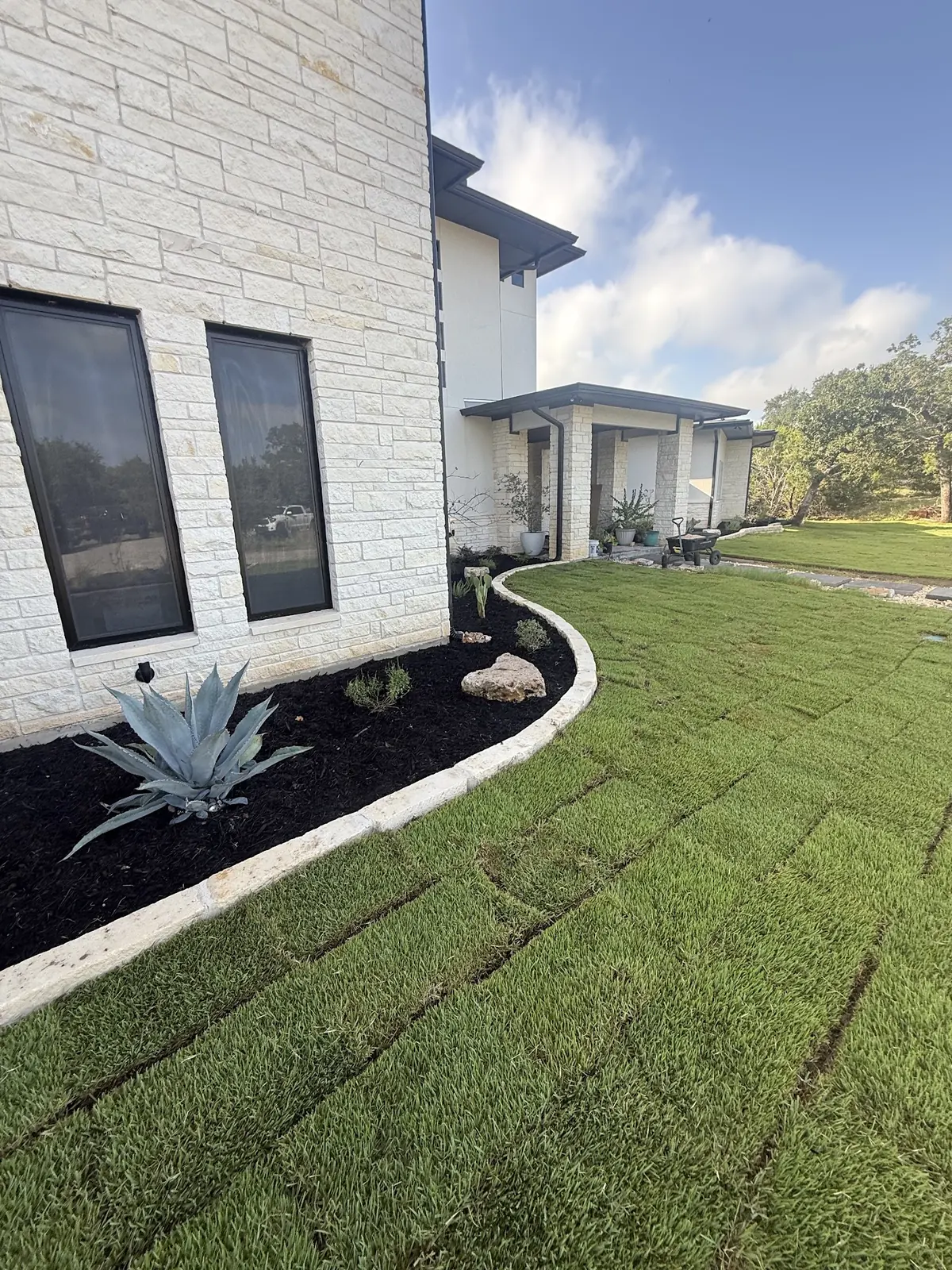
In practice, many Central Texas yards use both: rock around agaves and succulents that want dry, lean ground, and mulch around shrubs and perennials. Texas A&M’s WaterSmart program recommends coarse mulch 3 or more inches deep for weed control, and a curb edge keeps either one in the bed.
Local factors in Temple, Belton, and Killeen
Four local conditions shape what a Bell County yard costs: soil, summer heat, watering rules, and HOA requirements.
- Clay vs. limestone. Temple and much of Belton sit on Blackland Prairie clay that shrinks, cracks, and drains slowly. West toward Killeen and Harker Heights, shallow limestone makes digging slower. Both change prep costs.
- Summer heat. Planting in July and August means heavier establishment watering and more losses. Fall and spring installs give plants and sod time to root before triple digits.
- Watering rules. Cities in the area restrict landscape watering during drought stages. A plan built on low-water plants and less turf holds up better when the schedule tightens.
- HOAs. Many newer subdivisions have rules on front-yard turf, rock coverage, and plant lists. Check before you commit to a xeriscape front yard.
Agaves builds across the area; see the local pages for Belton landscape design and Killeen landscape design.
One price for the whole plan, and phasing a project
Getting one price for the whole yard is usually cheaper than buying it in pieces, because the plan decides where concrete, beds, and turf meet before anything is poured or laid. When pieces come from different contractors, the second one often tears out part of the first.
Phasing is still reasonable if the budget will not cover it all at once. The order matters:
- Plan the whole yard first. Even if you build a third of it, know where everything goes.
- Grading and concrete next. Patios and walks need equipment access that finished beds and sod would block.
- Curbing and beds. Edges set the lines the lawn will follow.
- Sod and planting last. Turf and plants go in after the heavy work, ideally in fall or spring.
Any sprinkler heads in the way of new concrete or beds should be moved in the same phase, not after the slab is poured.
Mistakes that cost homeowners money
Most overspending comes from buying in the wrong order, not from high rates.
1. Hiring on price alone
The lowest bid often leaves out prep, removal, or edging, and those come back as change orders. Compare what is included, not just the total.
2. Building piece by piece with no plan
A patio this year and beds next year, from different people, often means cutting new concrete or tearing out new sod to make them fit.
3. Planting for somewhere else
Plants that thrive in wetter climates struggle in a Bell County summer. Native and adapted plants cost the same or less and survive.
4. Skipping bed prep in clay
Setting agave or salvia straight into heavy clay invites root rot after a wet spell. Replacing dead plants costs more than preparing the bed once.
5. Installing in the heat
A July install can work, but it costs more in water and replacements. If the timing is flexible, fall is usually the better season to plant.
How to compare landscaping quotes
A real landscaping quote spells out every line item, so you can compare two bids line for line. Look for:
- Square footage of beds, turf, and concrete, and linear feet of curbing.
- Plant list with species and container sizes.
- Mulch or rock type and depth.
- Removal, haul-off, soil amendment, and grading, each listed.
- Concrete thickness, reinforcement, and finish for any patio or walk.
- Sprinkler changes and who handles them.
- Start date, sequence, and what happens if the scope changes.
Agaves gives a free written estimate after walking the property, and customers note there were no costs over the estimate. See finished yards on our work page, or request a consultation.
FAQs
THE SERVICE
Landscape Design from Agaves
An on-site consultation for the front and back of the house, then a plan and one price for the whole build.
Sources
- LawnStarter — How Much Does Landscaping Cost? — national; $4.50–$14.50/sq ft; size tiers 200–2,000 sq ft; design $1,390–$6,850; grading $1,175–$3,645; mulching $77–$94/cu yd; flower beds $865–$3,000; shrubs $25–$230, trees $565–$680; sod $0.60–$1.65; sprinklers $0.29–$0.48/sq ft; patio $8–$24/sq ft; lighting $2,000–$4,500; updated April 2026
- LawnStarter — How Much Does Landscape Design Cost? — national; $2,200–$6,180 per project; designers $50–$150/hr, landscape architects $65–$200/hr; updated Dec. 2025
- Lawn Love — How Much Does Landscaping Cost? — national; $3,300–$13,200 typical; design $1,900–$6,800; xeriscape $11,600–$20,000 for 1,200 sq ft; updated April 2026
- Fixr — Landscaping Cost — national; $5–$20/sq ft; detailed plan $2,000–$7,000; front yard $4,000–$6,000, backyard $8,000–$10,000; high end $20,000; Jan. 2025
- Lawn Love — How Much Does River Rock Cost? — national; $45–$140/cu yd, $60–$170/ton material; labor $40–$90/hr, about 2 hours per ton; updated Dec. 2025
- Calculating Concrete — How Much Does Concrete Curbing Cost? — national; $6–$14/ft installed, most $8–$10; updated July 2026
- HomeBlue — Concrete Patio Cost in Temple, TX — Temple, TX; plain $7–$11/sq ft, stamped $9–$16; April 2022
- HomeBlue — Sod Installation Cost, Temple, TX — Temple, TX; $1.20–$1.70/sq ft installed, about $1.40 average; July 2022
- Texas AgriLife Extension & City of Austin — Native and Adapted Landscape Plants — Central Texas plant guide; water ratings for agave, yucca, red yucca, salvias, Texas sage, lantana
- Texas A&M AgriLife Extension — Earth-Kind Plant Selection — native and adapted plants; turfgrass drought ratings; reducing lawn area
- Texas A&M WaterSmart — Mulching — coarse mulch 3 or more inches deep for weed control
More cost guides
TEMPLE, TEXAS — 31.0982° N, 97.3428° W
GET YOUR OWN NUMBER.
Averages only go so far. Sergio will walk the property with you and give you one price for the whole job — free, with no surprises after.